Fabulous Funky Fungi, of the California Kind have been popping up in the Late Bloomer garden! Water a little too much, and some mind-bending creation appears overnight.

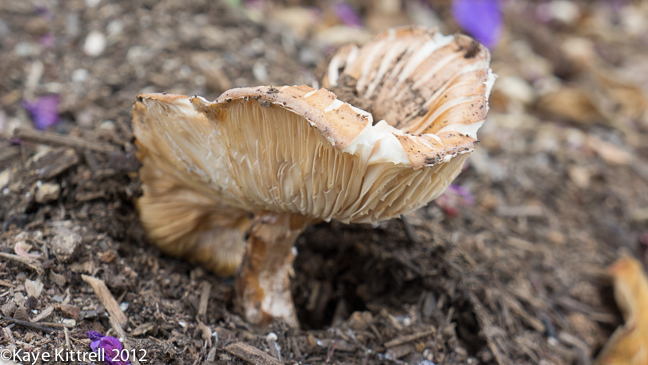
Pink-spored Pluteus atromarginatus. When I look at this photo.I think of Captain Jack Sparrow (from “Pirates of the Caribbean,” for those of you who have been on a deserted island for the past ten years).
Since I’ve been gardening for the past year and half, I have become keenly interested in insects and fungi. Did you know fungi are not plants? They have their own special kingdom of study. According to Fun Facts About Fungi (a great site for kids learning about fungi), “Living things are organized for study into large, basic groups called kingdoms. Fungi were listed in the Plant Kingdom for many years. Then, scientists learned that fungi show a closer relation to animals, but are unique and separate life forms. Now, Fungi are placed in their own Kingdom.” This makes me want to go back to school!
I was stumped early on by a couple of the fungi that popped up, so luckily I found MykoWeb, Mushrooms, Fungi, Mycology, a site that features The Fungi of California. Click the link to go to the Simple Key. Agarics, or Gilled Mushrooms, are listed at the top because they “are the most common group of mushrooms.” The photos on this site are excellent, but it can be time-consuming looking through hundreds of photos to identify your find.
So, when I discovered this alien creature in my garden and wanted to feature it in an earlier blog (with more photos of its life cycle) and an episode of “Late Bloomer,” I wrote to the site owner. He responded that it was a Pisolithus arhizus (aka P. tinctorius). The common name, Dog Turd Fungi, and you can see why!
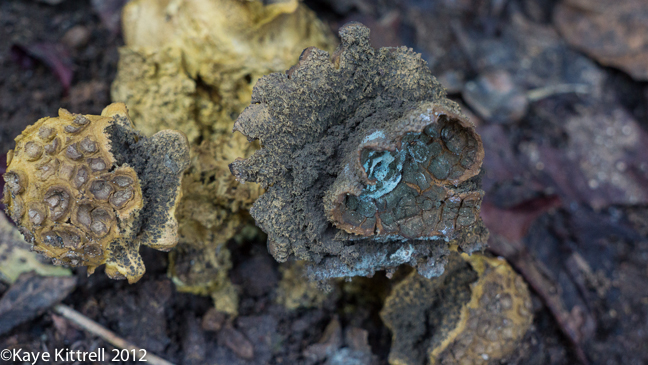
They emerge round and smooth and erupt into this, with a blue-colored “flower.” Before the flower appears, it can look like a pile of dog poop. In some countries, they refer to it as deer turd fungi. Then, within a couple of days, the show is over, and the whole thing disintegrates.
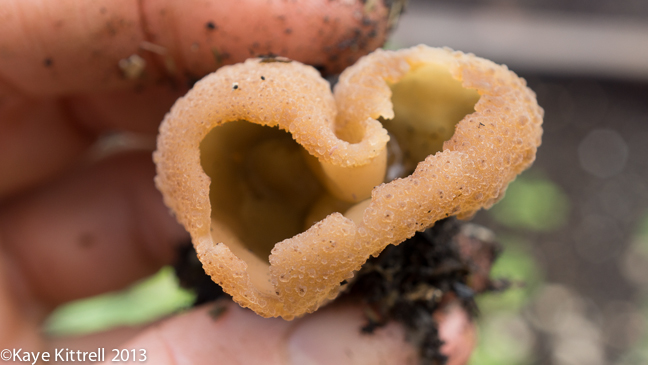
This Blistered Cup Fungi appeared at the end of January. Since I was born on Valentine’s Day, I’m particularly fond of heart shapes.
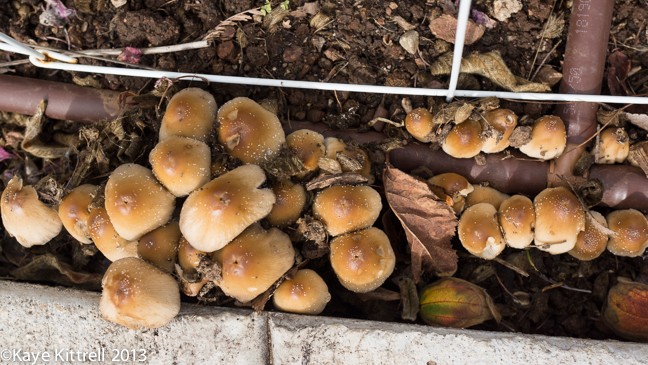
In fact, all of these mushrooms popped up from December to April, when we received some rain. It’s now mid-May, and we don’t expect to see a drop of rain for six months. So, if any mushrooms pop up, it will be due to a leak in the irrigation. These Black Gilled Agarics appeared around the drip-line I installed. (oops, bit of a leak there) Some connection with spores and water, I have a feeling!
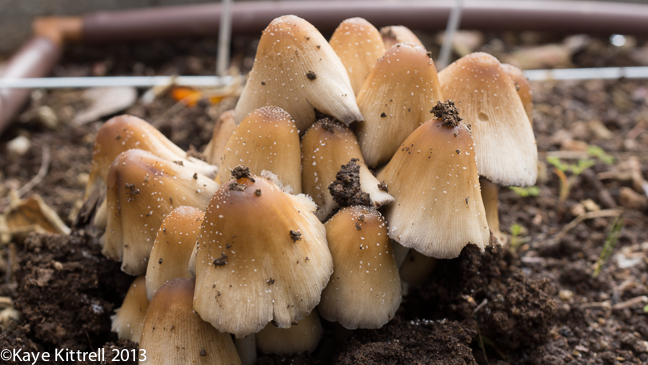
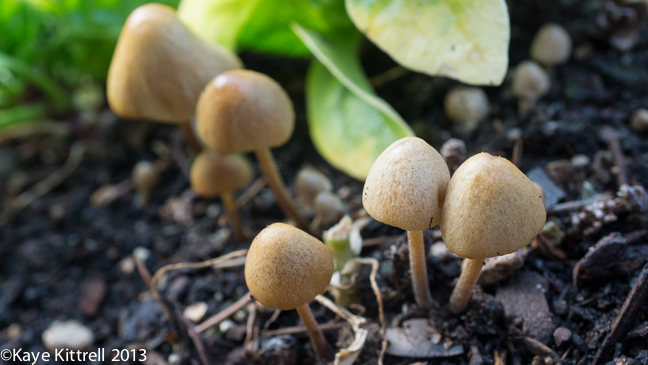
I always think of “Lord of the Rings” when I look at this photo! I’m kicking myself I did not get a shot of the underside of the cap. The gills were black! In modern parlance, this would be called a “photo fail.” Other small, white or tan Agarics that have pushed up:


How can you be sure of the gill, or spore, color? After all, they come in white, pink, brown, purple-brown and black. Just tilt it up to see!
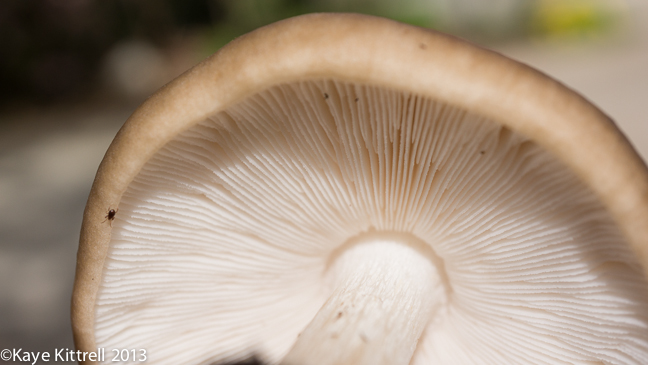
This tiny grouping popped up in a potted plant I had obviously over-watered.
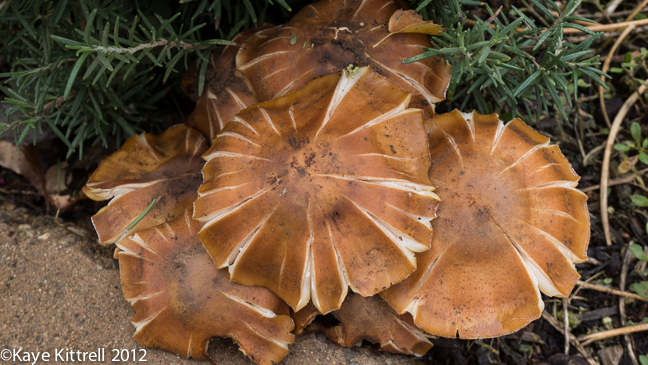
The tops of this massive fleshy Agaric cluster split immediately due to fast growth.
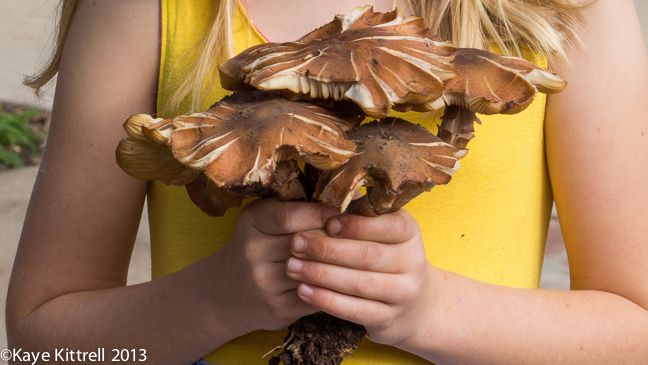
For scale, I had my ready garden helper Courtney pose with them as a bouquet.
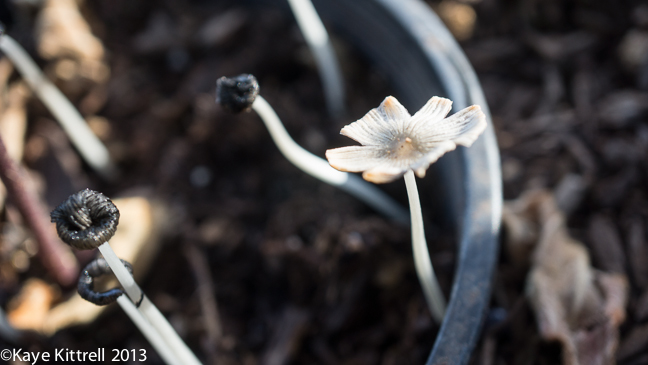
Next to last is the most delicate fungi I have found, Coprinopsis lagopus, a black-spored Agaric fungi. It first pushes up as a thin, translucent white stem with black shiny head.

Then the black separates into stripes, or black gills, as it opens to a delicate cup with edges turned in.
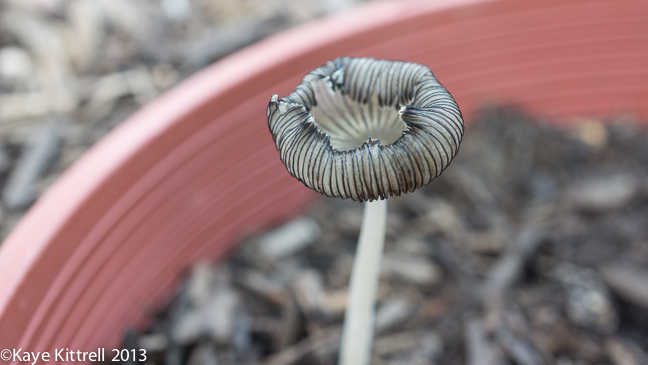
Then, the cap opens wide and splits. If you touch it, it disintegrates.
I’ve saved for last the most unusual, a phallic-shaped, Stinkhorn type fungus (yes, it does have a bad odor) Lysurus mokusin or Lantern Stinkhorn. The flies are attracted to the fruiting body which “imitates rotting flesh. The deception is irresistible to flies which carry off the olive gleba-bearing spores, helping disperse the species.” – MykoWeb
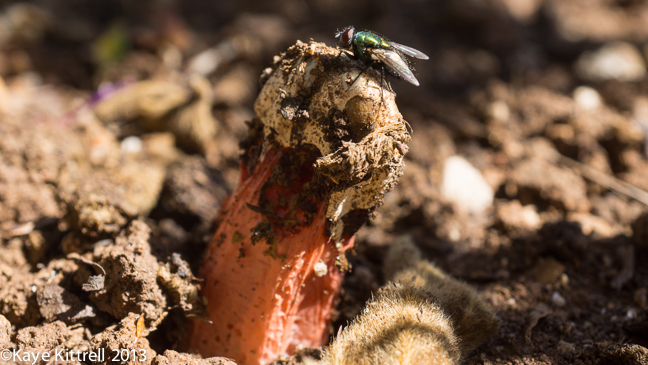
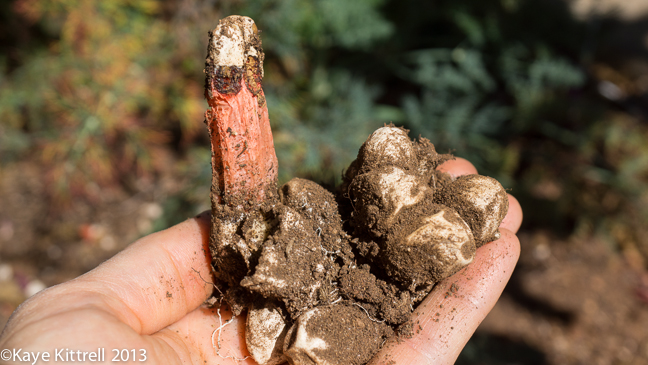
I had seen the photo at the link, but was not convinced that’s what I had popping up in my garden, until I wrote to the site owner and he informed me. Dozens of these white eggs appeared just under the surface, so I dug underneath a cluster and pulled this up. Each egg would have produced a hollow, pinkish shaft, with the egg sac remaining on the head. Within hours of appearing, they wilted and shriveled. (smile)
I hope you enjoyed my foray into fungi foibles! Thanks for stopping by “Late Bloomer” and I promise to continue entertaining, enlightening, and hopefully, occasionally, dazzling you, with my photos of glorious, marvelous nature. Comments are welcome! Please share with your fungi friends!
If you enjoyed this post, please let me know. Thanks for your support! ~ Kaye

I receive a small commission for promoting products I’ve used and believe in. Your support of these products helps me to continue to produce “Late Bloomer” episodes. Click button to order products! Help me inspire people to grow their own food and take control over their food security. Your donation of any amount makes “Late Bloomer” possible and available for anyone.
Thank you!