I was doing some research last night trying to find out what was wrong with my lemon tree. Though I have more than a dozen green lemons developing, the leaves don’t look so good. I decided to take a closer look. On the undersides of a few leaves, I saw cottony puffs and an ant madly racing around. Upon closer inspection, they appear to be Mealybugs. Ants farm mealybugs (and aphids) for their sugary excretions called honeydew. I gave the leaves a quick wash, and removed infected leaves.

I moved to the parkway, as I had also been reading about cucurbit pests. And I found scale on the backs of leaves of the Japanese cucumber. I just harvested two good ones two days ago, but the leaves all look pretty bad.

There are a host of issues here, but the most visible is leaf miner.

Something is eating the leaves, I suspect it’s goldfinches who also shredded my sunflower leaves (I watched them do it!)

At this point, I saw tiny beetles on the backs of leaves running around. I first thought they might be a pest, but thought they might be a tiny version of a lady beetle, which eats the scale, mealybugs, and aphids (the terrible 3!), so I left them alone. It took blowing the photos up on the computer before I was sure they were beneficial lady beetles.

Here’s one in a larvae stage. They are only about 1/16 of an inch long.

This disease eats right through the leaves from the back to the front, I think.

This lady beetle was racing around on the back of a leaf covered in this waxy scale. I hope it eats it all!

This is the work of leaf miner. I read they have several stages as they burrow through the leaf, getting larger and larger. That’s pretty evident if you look at the beginning of the line and the end of it. It would appear that it has metamorphosed and emerged from the leaf at the fat end.

Moving on to my Japanese melon right beside the cucumber, I’m hoping these dents do not mean this emerging melon is infected with something!

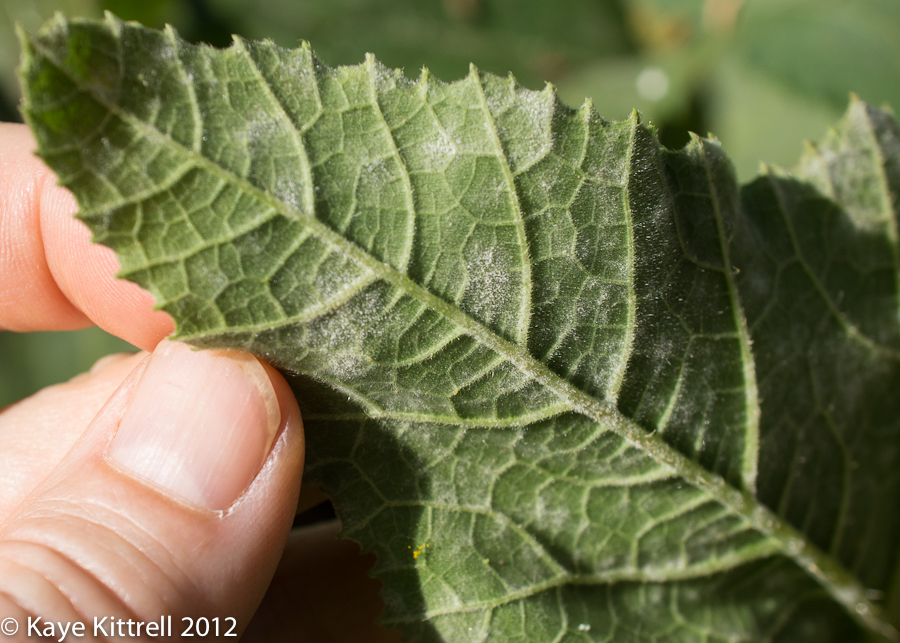
My patty pan squash is but three feet away, and once again, the powdery mildew is back! (2015 update, I spray regularly with Neem oil at the first sign of spots, before PM gets to this stage.) At this stage, I remove leaves, spray and wait to see if the plant recovers. Also adding compost and earthworm castings around the stem is helpful to give it added nitrogen.

There are white spots on front and back. Time to spray with my milk solution again. (Update: Milk solution only works if you use it when you first see spots. At this stage, the plant is overwhelmed.) Two beautiful squash are growing, so it doesn’t seem to be slowing growth, yet. (But, it will!)
Thank God for the pollinators. There was a bee clinging to this leaf in the breeze, and when it would settle, the bee would groom itself. You can see its back covered in pollen. There are a few big blooms on the patty pan squash, so, I guess it was about to dive back into the bloom.

Cucurbit Issues, or trouble in the parkway, is all about what’s going wrong with plants. I guess it was a good thing I didn’t know about cucurbit diseases and pests before I planted them. After researching diseases and pests, I felt a little queasy. For sure, I learned that cucurbits with certain diseases must be removed from the garden, and not planted in the same spot the following year. One resource said you have to plant them at least a quarter mile away, as fungal spores travel on the wind for a quarter of a mile! My front garden is tiny, so I’m not sure if I will be able to plant cucurbits next year. (Update 2015: I had more success this year, with lemon cucumber, and lemon squash, which are fast developing, and I have been more vigilant with spraying, and using compost and compost tea.)
Gardening is an adventure! Thanks for reading and please share! – Kaye

I receive a small commission for promoting products I’ve used and believe in. Your support of these products helps me to continue to produce “Late Bloomer” episodes to inspire people to grow their own food and take control over their food security. Click on links or photos to order products! Thank you!
Help me inspire people to grow their own food and take control over their food security. Your donation of any amount makes “Late Bloomer” possible and available for anyone.
Thank you!